
Irish immigration stamps explained: what each one allows and whether it counts
Published 13/10/2026
In short: your stamp says what you may do in Ireland and for how long. Some stamps count towards the residence you need for citizenship and some do not. This post follows the Immigration Service Delivery (ISD) stamps page, last updated by ISD on 5 June 2026, and was checked on 13 October 2026.
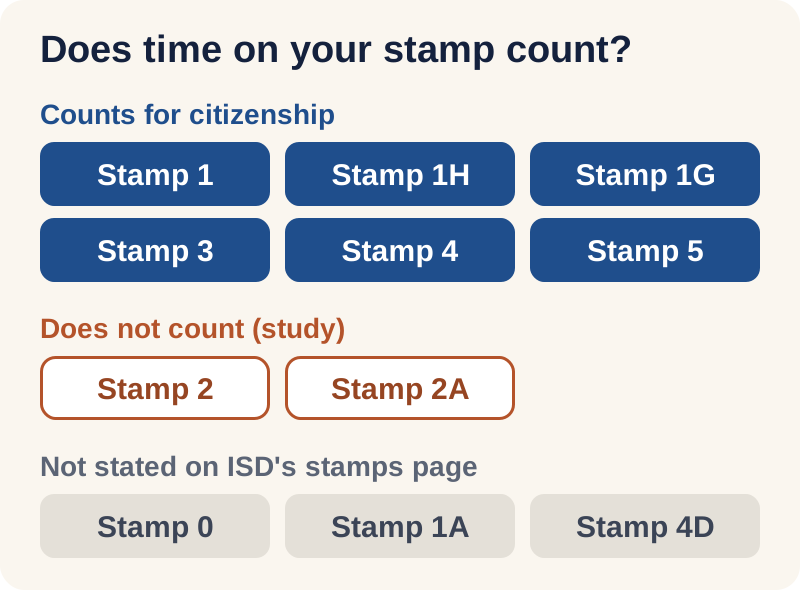
What a stamp is
If you come from outside the EU, EEA, UK and Switzerland and stay longer than 90 days, you need an immigration permission. Each type of permission has a stamp number. The number is printed on your Irish Residence Permit (IRP) card and may also be stamped in your passport.
ISD's page says the time you build up on certain stamps "may be used to calculate your reckonable residence (subject to conditions)" when you apply for citizenship. Reckonable residence is simply residence that counts.
The stamps at a glance
| Stamp | Typically for | Work | Counts for citizenship? (ISD stamps page) |
|---|---|---|---|
| Stamp 0 | Temporary stay for people of independent means, visiting academics, elderly dependent relatives | No, unless your ISD letter says so | Not stated on that page |
| Stamp 1 | Work with an employment permit, running a business, Working Holiday Authorisation | Yes, with a permit or an ISD letter | Yes |
| Stamp 1H | Hospital doctors on a two-year multi-site permit | Yes, as a doctor in public hospitals | Yes |
| Stamp 1A | Trainee accountants | Paid accountancy training only | Not stated on that page |
| Stamp 1G | Graduates looking for work; spouses and partners of Critical Skills permit holders and of researchers | Yes, no permit needed; no self-employment | Yes |
| Stamp 2 | Full-time study on a listed (ILEP) course | Casual work: 20 hours a week in term, 40 in holidays | No |
| Stamp 2A | Full-time study on a course not on the list | No | No |
| Stamp 3 | Volunteers, ministers of religion, family of some work-permit holders | No | Yes |
| Stamp 4 | See the list below | Yes, no permit needed; may run a business | Yes |
| Stamp 4D | Family members of UK citizens who came to live here after 1 January 2021 | See ISD's Brexit policy | Not stated on that page |
| Stamp 5 | Permission "without condition as to time" | No conditions listed | Yes |
| Stamp 6 | Irish citizens with dual citizenship, in their other passport | Yes | Not relevant: you are already a citizen |
Where the table says "not stated", ISD's stamps page gives no line on citizenship for that stamp. Check ISD's citizenship guide or ask ISD before relying on that time.
A closer look at the common ones
Stamp 1
For people working on an employment permit or running a business with permission. You may not start a job unless you or your employer holds a permit for it, or your ISD letter clearly says you do not need one. A Working Holiday Authorisation also gives Stamp 1, but it cannot be renewed and you must leave when it ends.
Stamp 1G
Two different groups hold it:
- Graduates who have finished their studies here, under the Third Level Graduate Programme. It is given for 12 months, with a further 12 months possible after a master's degree.
- Spouses and de facto partners of Critical Skills Employment Permit holders and of researchers on a Hosting Agreement. It is renewed each year, and after 5 years on Stamp 1G you may apply for Stamp 4.
ISD's page says time on Stamp 1G in either group counts as reckonable residence for citizenship.
Stamp 2 and Stamp 2A
Both are for study, and ISD's page says plainly that neither counts as residence for citizenship. On Stamp 2 you can study for at most 7 years in total and must show progress each year. English-language students need at least 85% attendance and can register for at most three 25-week courses.
Years spent as a student are often the reason a person's "years in Ireland" and their "reckonable residence" are different numbers.
Stamp 3
You may live here but may not work or run a business. It is common for family members of people on work permits. It counts for citizenship.
Stamp 4
The most flexible stamp: you can work without a permit, practise a profession and run a business. ISD lists these ways of getting it:
- after 2 years on a Critical Skills Employment Permit
- after 5 years on an employment permit
- after 2 years as a researcher on a Hosting Agreement
- as the spouse, civil partner or de facto partner of an Irish citizen
- as a refugee or a person with subsidiary protection, or their family member
- as the parent of an Irish citizen child
- under the Investor and Entrepreneur Programme
- as Long Term Residence
Stamp 5
Permission to stay "without condition as to time". It is valid until your passport expires, and you apply to ISD for it before registering.
Rules that apply to every stamp
- Register your permission with ISD within 90 days. If you cannot get an appointment in time, ISD says it will not cancel your permission, but you must be able to show you tried.
- Renew before your permission expires. A gap between one permission ending and the next starting is a gap in your residence record.
- Obey the law and stay out of trouble with the Gardaí. ISD says a breach can mean your permission is not renewed, or is revoked.
- Read your permission letter. The Minister can attach extra conditions that are not printed on the card.
EU, EEA, Swiss and UK citizens
You do not get a stamp, because you do not need immigration permission to live in Ireland. Family members who rely on EU Treaty Rights have their own permissions; ISD has a separate page for those.
What to do with this
- Write down every stamp you have held, with its start and end dates. Old IRP cards, passport stamps and permission letters all help.
- Look for gaps between one permission and the next.
- Remember that reckonable years are only one of the conditions for citizenship.
You can do this in IrishReady: add your stamps to your timeline, and the free residence check shows which periods count under the current rules and where the gaps are.
Official sources
- Immigration permission/stamps (Immigration Service Delivery, last updated 5 June 2026)
- How to become an Irish citizen (Immigration Service Delivery)
This is general information, not legal advice. IrishReady is independent of ISD and the Government.