
The 2026 Citizenship Bill: what is proposed and what has not changed
Published 13/10/2026
In short: nothing has changed yet. The Government has published a plan for a new law, called a General Scheme. It is not law, it has no start date, and today's rules still apply to every application. This post was checked against the official text on 13 October 2026.
Where things stand
- 9 September 2026: the Government approved priority drafting of the Irish Nationality and Citizenship (Amendment) Bill 2026.
- 21 September 2026: the Department of Justice, Home Affairs and Migration published the General Scheme, which is the outline of what the Bill is to contain.
- Next: the Scheme goes to the Joint Committee on Justice for pre-legislative scrutiny. After that a full Bill must be drafted, debated and passed by the Dáil and Seanad, and signed.
- Start date: none. The Scheme says the Act would come into operation on a day or days the Minister appoints by order, and different parts could start on different days.
A General Scheme often changes before it becomes law. Read everything below as "proposed", not "decided".
The main proposals
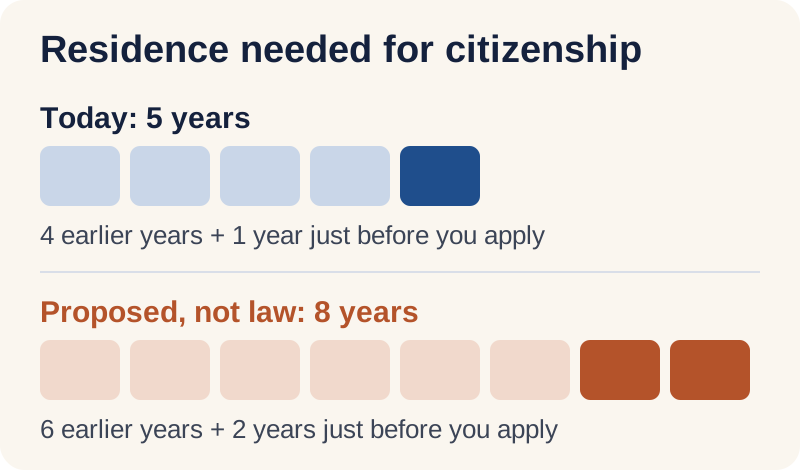
1. Longer residence: from 5 years to 8
| Today | Proposed | |
|---|---|---|
| Continuous residence just before you apply | 1 year | 2 years |
| Earlier residence | 4 years in the 8 years before that | 6 years in the 10 years before that |
| Total | 5 years | 8 years |
2. Spouses and civil partners of Irish citizens
| Today | Proposed | |
|---|---|---|
| Married or in a civil partnership for at least | 3 years | 5 years |
| Continuous residence just before you apply | 1 year | 2 years |
| Earlier residence | 2 years in the 4 years before that | 3 years in the 5 years before that |
| Total residence | 3 years | 5 years |
The offences, language and civics conditions described below would apply to spouses and civil partners too.
3. A language requirement
Applicants would have to show proficiency in Irish, English or Irish Sign Language. The Scheme does not set the level or say how it would be tested. Both are left to regulations the Minister would make later.
4. A civics requirement
Applicants would have to show knowledge of Irish civics, society and politics. Again, the standard and the form of the test are left to later regulations.
The Scheme lets the Minister waive the language and civics conditions in circumstances to be set out in regulations. Its explanatory note says this is so the requirements do not unfairly affect vulnerable applicants.
5. Self-sufficiency
An applicant would need "sufficient resources" so as not to become an unreasonable burden on the State. The Scheme says this would be met where the applicant:
- has at least a minimum income, at the time of applying and while the application is being processed. The amount is not in the Scheme; the Minister would set it, having regard to CSO figures on earnings and the cost of living.
- is not receiving a listed social welfare payment or housing support, and has not received one in the 2 years before applying. The Minister could still grant an application where the support lasted no more than 6 months in total in those 2 years. Which payments and supports are on the list is left to regulations.
- does not owe money to Revenue or the Department of Social Protection, and has no unpaid court fine.
6. Immigration offences
A person who has committed one of a listed set of immigration offences, before or after applying, could not be granted naturalisation. The list is in Schedule 1 of the Scheme.
7. Conditions that continue while you wait
Applicants would have to keep living in the State, and keep meeting the good character, self-sufficiency and offences conditions, until the Minister decides. The Scheme also says the good character condition could never be waived.
8. Residence that would stop counting
The Scheme would remove some kinds of permission from reckonable residence:
- time in Ireland under Temporary Protection
- time on a temporary permission while an EU Treaty Rights application or review is examined, where the person is later found not to be entitled
- time where an EU Treaty Rights entitlement was claimed through fraud or abuse of rights
- other temporary or limited permissions the Minister may list in regulations
An important protection: the explanatory note says these changes to reckonable residence would not apply to someone who has already submitted a naturalisation application before the law starts.
9. Revoking citizenship
A new ground would allow a certificate of naturalisation to be revoked in the interests of public policy, public order or national security.
What the Scheme does not tell us
- When any of this would start. There is no date.
- What happens to people part-way through their 5 years. The Scheme states a protection for applications already submitted in relation to the reckonable-residence changes in point 8. We did not find an equivalent statement for the move from 5 years to 8. That may be settled when the full Bill is published.
- The language level, the civics test and the income amount. All three are left to regulations.
What this means for you today
- The current rules apply. If you already meet them, the proposal does not stop you applying now.
- Keep your record complete and current: stamps, addresses, trips and one strong document for each year. That is useful under the current rules and under the proposed ones.
- Do not make a big decision on the strength of a news headline. If timing matters in your case, speak to a solicitor.
IrishReady calculates your residence under the law as it is today. We track this Bill, and the app will not apply a proposed rule to you until it becomes law.
Official sources
- General Scheme of the Irish Nationality and Citizenship (Amendment) Bill 2026 (gov.ie)
- Government press release, 9 September 2026 (gov.ie)
- How to become an Irish citizen (Immigration Service Delivery, the current rules)
This is general information, not legal advice. IrishReady is independent of ISD and the Government.